
The management of a mutual fund in Sweden requires that the fund management company is authorised by the Swedish Financial Supervisory Authority, pursuant to the Swedish Mutual Funds Act (2004:46) (LVF).
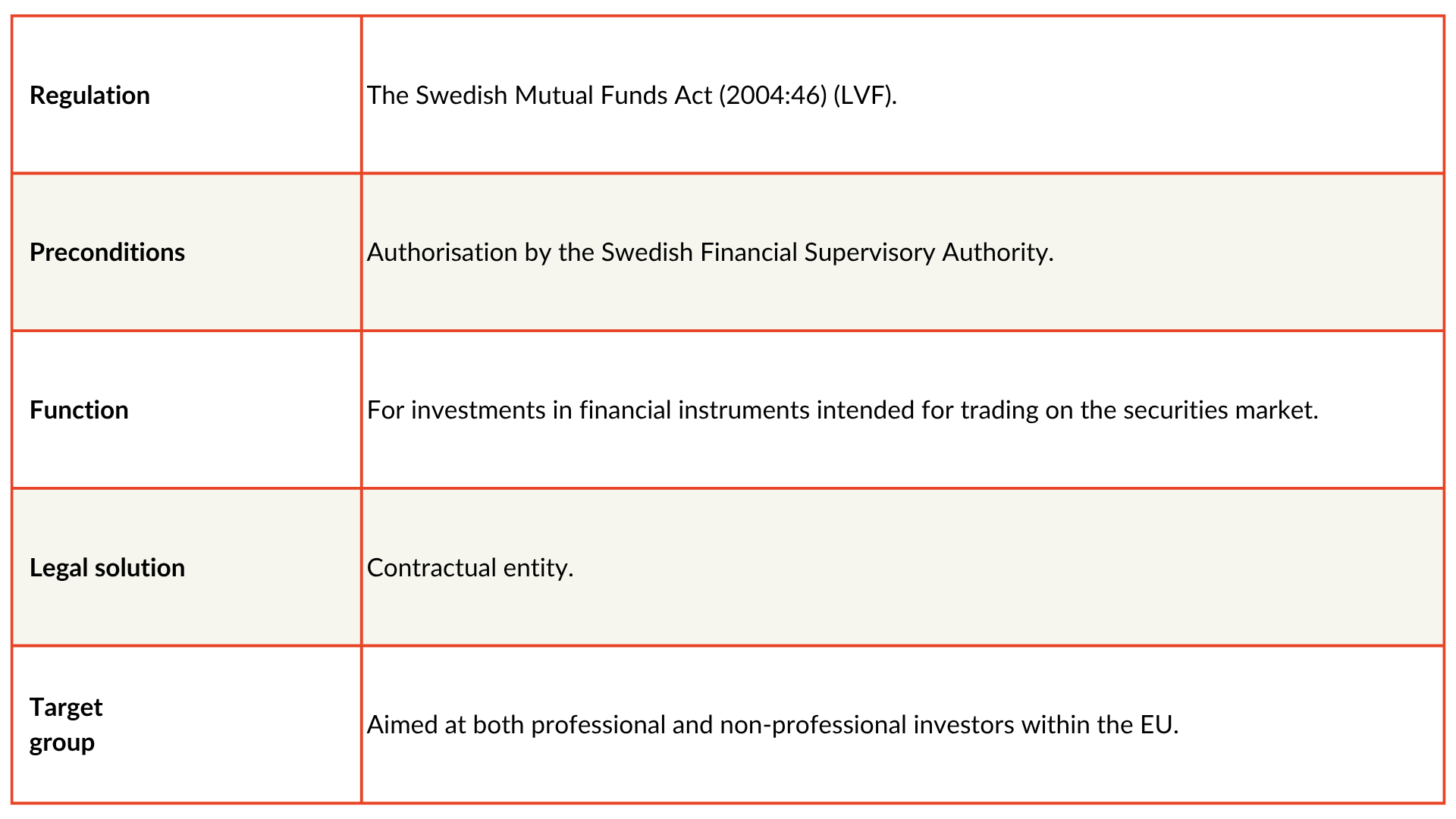
A fund management company must, in order to carry out fund management operations, be authorised by the Swedish Financial Supervisory Authority. The authorisation allows the company to establish and manage mutual funds. In addition, the fund rules for every mutual fund must be approved by the Swedish Financial Supervisory Authority before the fund can be launched.
The fund management company is responsible for the management of the fund, including portfolio management, risk management, regulatory compliance, and investor protection. A mutual fund is the Swedish form of a European UCITS (Undertakings for Collective Investment in Transferable Securities), i.e. a fund that complies with the provisions of Directive 2009/65/EC on the coordination of laws, regulations and administrative provisions relating to undertakings for collective investment in transferable securities (the UCITS Directive). Unlike in some other EU Member states, where a UCITS may be structures as a company or a trust, Swedish mutual funds are always contractual structures without legal personality.
A mutual fund may be divided into different unit classes, which means that several groups of investors can hold units in the same fund but on slightly different terms. The fund’s assets and the management are always the same, but the unit classes may differ regarding, for example, fees, whether returns are distributed or reinvested, and whether the units are currency-hedged.
A mutual fund can be marketed in other member states through the EU’s passporting regime. This enables the fund to be offered and distributed cross-border within the EU in a regulated and transparent manner.
The Swedish Mutual Funds Act (2004:46)(Swedish)