The choice of fund type depends on the nature of the intended activities, the assets to be managed, and the type of investors the fund is intended to.
Mutual funds (UCITS, Undertakings for Collective Investment in Transferable Securities) are regulated under a harmonised EU framework designed to protect investors. This type of fund is well suitable for management companies seeking to offer products with high transparency and strict requirements on risk diversification and liquidity. Mutual funds primarily invest in listed assets and are aimed at both professional and non-professional investors. A key advantage of mutual funds is that they can be easily marketed across the EU (and EEA) through the so-called passporting regime, making them attractive to fund management companies with international ambitions.
Alternative investment funds (AIFs) are regulated in accordance with a harmonised EU framework designed, amongst other things, to enhance investor protection and increase transparency. This fund type is suitable for managers seeking greater flexibility in terms of investment strategies, risk profiles, and asset classes. AIFs may, for example, invest in real estate, infrastructure, credit strategies, or unlisted companies.
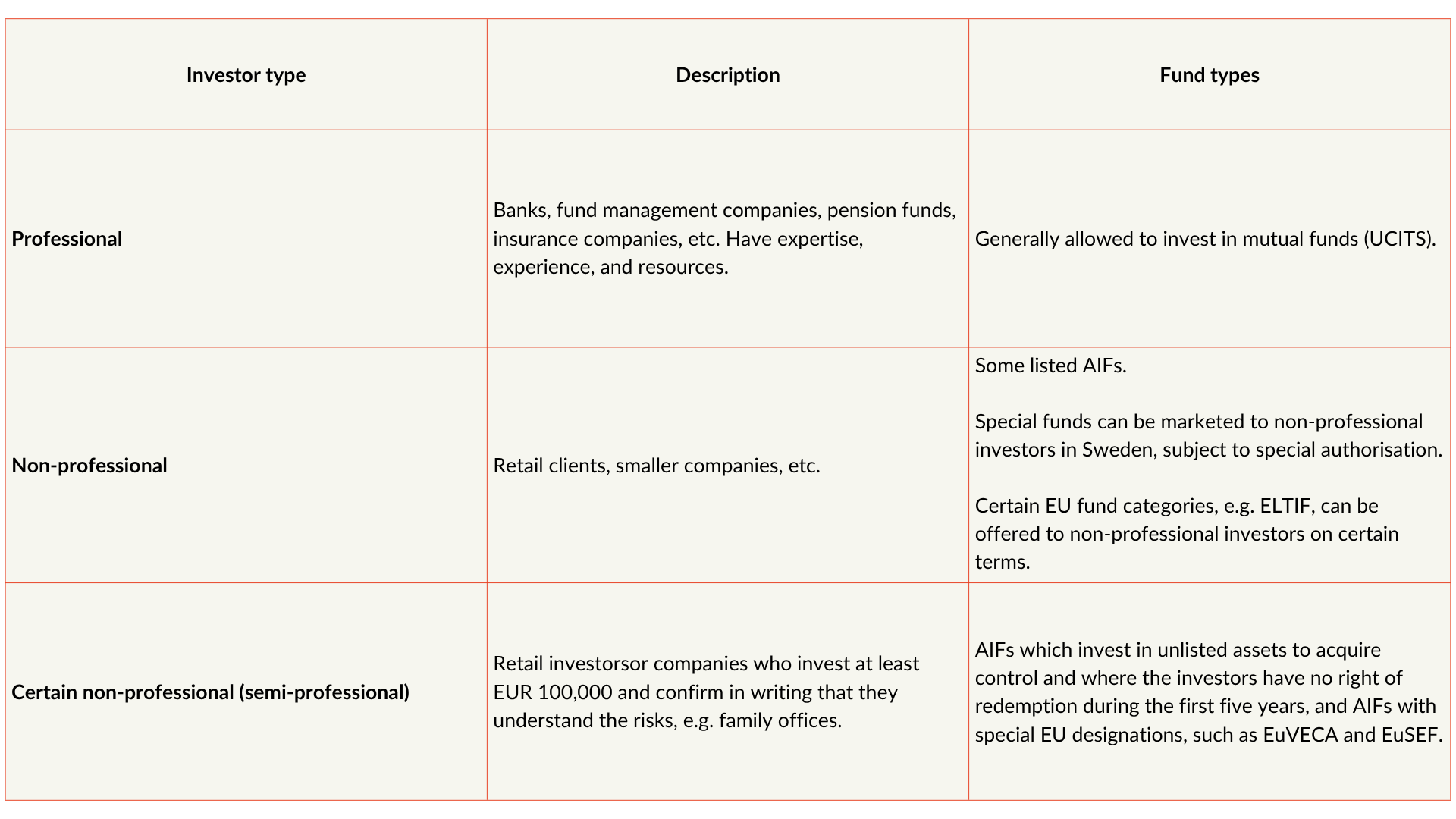
AIFs are typically aimed at professional investors, although some are also open to non-professional investors.
Who is allowed to invest in which type of fund?
Legal fund structures
The choice of fund structure is an important factor when establishing fund operationsin Sweden, as mutual funds and alternative investment funds entail different legal frameworks and possibilities.
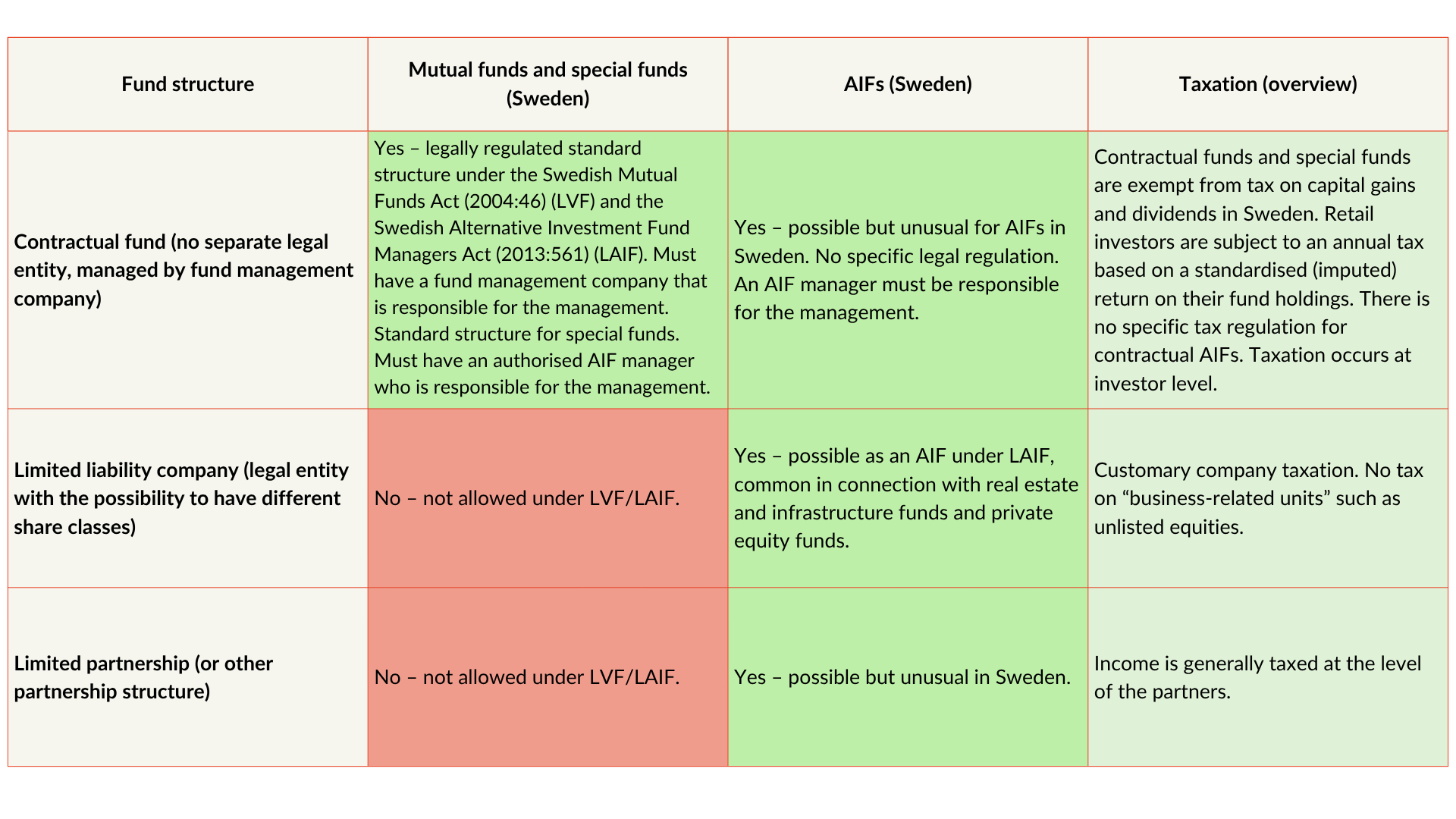
Mutual funds must, under Swedish law, be contractual in nature., i.e. the fund is not a separate legal entity, but is managed by a fund management company authorised by the Swedish Financial Supervisory Authority. This also applies to exchange-traded funds (ETFs).
Alternative investment funds (AIFs) offer greater structural flexibility. They may be established as corporate entities, for example as limited liability companies or limited partnerships, but can also be contractual. This flexibility is utilised by fund types such as private equity funds, real estate funds, and infrastructure funds.
There are several different types of AIFs. A special fund is a Swedish category of AIF that requires specific authorisation under the Swedish Alternative Investment Fund Managers Act (2013:561) (LAIF), and, unlike other AIFs, may be marketed to non-professional investors. The regulation of special funds shares similarities with the UCITS regulation but allows greater flexibility in terms of investment strategy, use of derivatives, and redemption frequency. In addition, there are EU-level AIFs classifications, such as EuVECA and EuSEF, which are governed by EU directives, and which have their own requirements regarding structure and investment focus.