
An alternative investment fund (AIF) may pursue a wide range of investment strategies and is not subject to the same limitations as a UCITS fund. This means that an AIF can invest not only in traditional securities, but in other types of assets such as real estate, unlisted companies, or infrastructure.
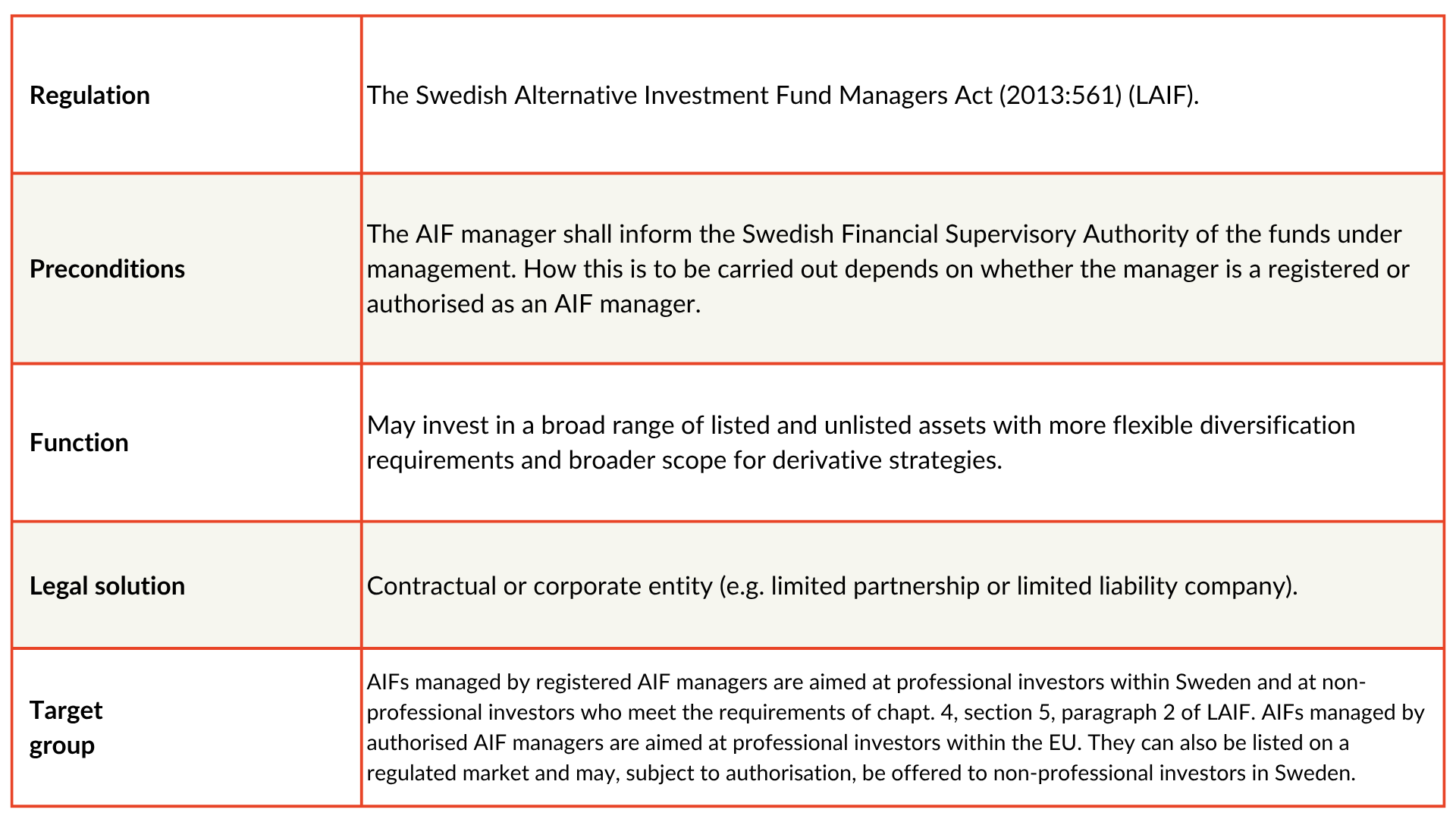
It is the AIF manager who is regulated, not the fund itself. In Sweden, the rules are set out in the Swedish Alternative Investment Fund Managers Act (2013:561) (LAIF), which is based on Directive 2011/61/EU on Alternative Investment Fund Managers (the AIFM Directive).
An AIF manager must be registered with or authorised by the Swedish Financial Supervisory Authority in order to manage an alternative investment fund (AIF). A manager whose assets under management exceed the threshold values set out in chapt. 2 of LAIF must obtain authorisation from the Swedish Financial Supervisory Authority.
Authorised AIF managers (authorised managers) are subject to the full set of provisions of LAIF, whereas registered AIF managers are only required to comply with a limited subset of the rules.
The key strength of the AIF structure lies in its flexibility. Unlike mutual funds, AIFs may apply investment strategies and rules that deviate from traditional frameworks, such as the use of leverage, investment in illiquid assets, concentrated portfolios, or derivative-intensive strategies. This allows for the development of tailored products suited to specific investor groups and investment objectives.
As a general rule, AIFs are aimed at professional investors, but in certain cases they may also be offered to non-professional investors. Depending on the fund’s type and strategy, specific restrictions or enhanced disclosure, requirements may apply. Special funds, a Swedish category of AIFs, may under certain conditions, be marketed to non-professional investors, i.e. the general public. This requires, amongst other things, authorisation by the Swedish Financial Supervisory Authority.
AIFs are well suited for managers seeking to establish more specialised and alternative investment solutions outside of the regulatory framework for mutual funds, while still operating in a regulated and supervised structure. They offer significant opportunities, but also entail a responsibility to handle complexity, risk, and transparency in line with applicable rules.
The Swedish Alternative Investment Fund Managers Act (2013:561)
Directive 2011/61/EU on Alternative Investment Fund Managers